




- How Bloggers Make Money in 2026
- 22 Common Mistakes New Bloggers Make and How to Avoid Them
- Why your Blog Needs a Sales Funnel (and How to Create one That Converts)
You finally hit publish on that epic blog post…and then? 🦗🦗🦗 Your blog needs a sales funnel.
What is missing is a system to turn lurkers into loyal buyers. This post will walk you through the “why” behind funnels, plus a no-fluff guide to building one that works (even if you’re allergic to tech).
Disclaimer: This post may contain affiliate links. If you click on them, I may earn a commission, at no additional cost to you. See my disclaimer page for more information.
What is a Sales Funnel (and why you need one, like yesterday)
A sales funnel for your blog is a step-by-step journey that your readers take to go from casual browsing to loyal subscribers and eventually, paying customers. Think of the sales funnel like this:
- Readers find your blog through Google search, Pinterest, or social media.
- They grab your freebie (your lead magnet) and give you their email to become a subscriber to your email list.
- You nurture this list of subscribers through a series of emails that build trust and deliver value.
- You introduce your offer (like a digital product, online course, or service, etc.).
- They buy your paid offer and you earn passive income.
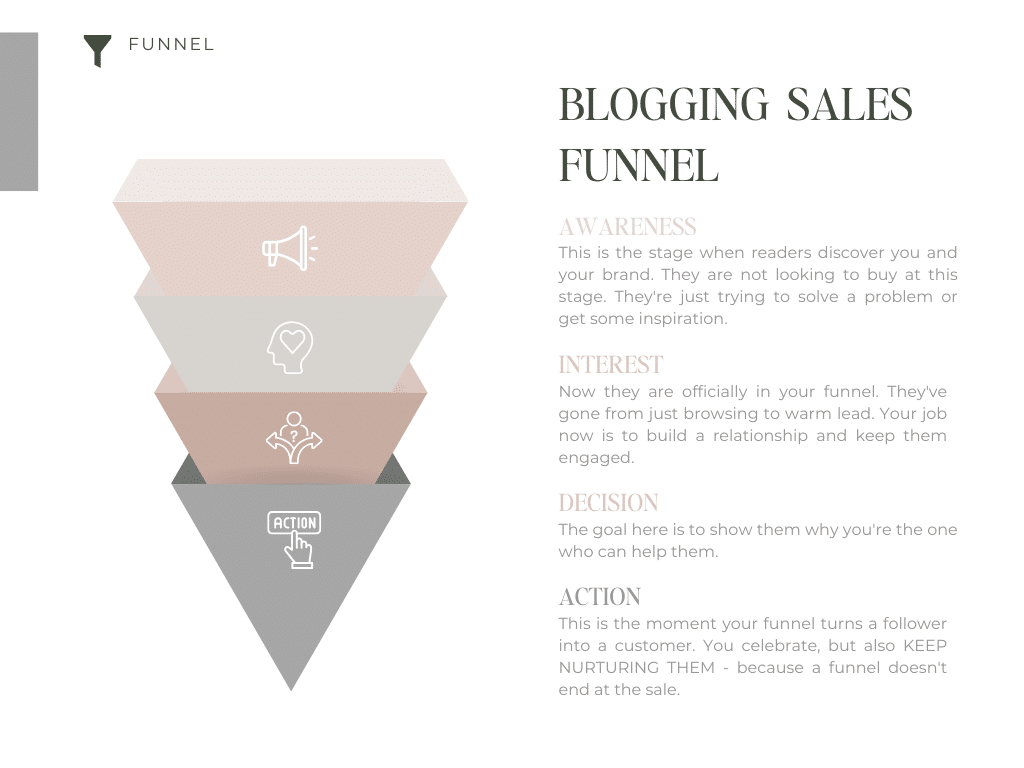
The sales funnel is called a funnel for a reason:
👉 At the top of the funnel, there are alot of people that enter here through your blog content.
👉 As they move down the funnel to the middle, you guide them with value-packed emails and offers, but some people drop off here.
👉 At the bottom of the funnel, more people drop off, and you are left with the people who are most aligned, ready to buy, readers who want to take action and purchase from you.
Why Your Blog Needs a Sales Funnel
A common blogging mistake is driving traffic with no system to convert.
A blog is like spotting a problem. A funnel is offering the solution.
Having a blog without a sales funnel is like being a nurse who documents every single patient symptom in the chart, but never calls the doctor, gives the meds or starts a treatment plan.
You’re doing a ton of work.
You’re showing up.
You’re writing all the notes (hello, blog posts). But there’s no action being taken to actually help the patient improve.
In other words, you’re creating valuable content, but you’re not guiding your reader to the next step-whether that’s downloading your freebies, joining your email list, or buying a digital product. They’re just sitting there, passively reading, and not getting results. And you’re not getting paid.
With a blog sales funnel, you are guiding readers to exactly what they need to get results and buy from you. AKA: you go from just helping for free to building a business that serves AND sells.
If you want to turn traffic into income, you need a funnel.
How the Sales Funnel Works
1. Awareness: “Hey, who’s this?”
This is the stage when readers discover you and your brand. This may be on Google search, Pinterest, or on social media. They are not looking to buy at this stage. They’re just trying to solve a problem or get some inspiration. This is your chance to:
- Show up on search results or social feeds
- Deliver SUPER VALUABLE blog content
- Make a KILLER first impression (think clear brand, clear messaging, easy-to-navigate website)
🌟 The goal here is to help readers realize you get them.
2. Interest: “Oooh, I like her!”
Now they are intrigued. You’ve got something they want, like a free checklist, a clever blog strategy, or a way to make passive income without selling their soul (your lead magnet). You offer them a juicy freebie in exchange for their email address.
Now they are officially in your funnel. They’ve gone from just browsing to warm lead. Your job now is to build a relationship and keep them engaged.
🌟 The goal here is to spark curiosity and get them on your email list (so you can nurture them and build trust).
3. Decision: “Should I trust her with my money?”
This stage is where they are weighing their options. They have received your emails, maybe poked around your products/services that you’ve introduced in the emails, and they’re trying to decide if your offer is worth it.
This is where your email nurture sequence comes in:
- You share relatable stories, quick wins, and social proof
- You handle possible objections like “will this work for me?” and “why should I buy from her?”
- You show the transformation your product delivers
🌟 The goal here is to show them why you’re the one who can help them.
4. Action: “Let’s do this!”
They click the link. They buy the thing. WOOT!
This is the moment your funnel turns a follower into a customer. You celebrate, but also KEEP NURTURING THEM – because a funnel doesn’t end at the sale.
🌟 The goal here is to make it easy for them, to say yes.
Listen here, every piece of your funnel-your blog, your emails, your offer-should gently guide them from “I don’t know her” to “TAKE MY MONEY”.

What a Sales Funnel can Actually do for You
1. Capture Leads 24/7
That freebie that you offer? It gives you a direct line to your reader’s inbox when they sign up for it. And automations with your email marketing platform allow you to deliver this value to your readers at all times of the day, even while you sleep.
2. Builds Trust while You’re Living Your Life
With a well-written welcome and nurture sequence, your new subscribers start getting to know you, like you, and trust you-all while you’re wrangling the kids, meal prepping, and binge-watching The Secret Lives of Mormon Wives.
3. Converts Warm Leads into Paying Customers
Your blog sales funnel is the cozy, confidence-building warm-up that makes people want to say “YES” to your offer.
4. Puts Your Income on Autopilot
The goal is to turn your blog into a machine that consistently delivers value and makes sales…even when you’re off duty.
The 5 Key Pieces of a Blog Sales Funnel That Converts
1. The Lead Magnet
This is a freebie that solves a very specific problem and is so irresistible that they’ll trade their email address for it. The lead magnet should also be directly related to your paid offer.
2. The Landing Page
This is where the magic happens-where they say “yes” and sign up. The landing page is where you spell out the benefits of your offer. A high-converting landing page includes:
- A bold, benefit-driven headline
- A short description of what they’ll get
- A visual (mockup, photo, or preview)
- A super clear call-to-action (CTA)
Don’t distract them with your latest blog post or social links here. Most landing pages don’t even have a navigation bar. The sole focus of the landing page is the opt-in.
3. The Welcome Sequence
This is like your digital handshake. Once they opt-in, they should immediately receive:
- their freebie (don’t make them dig for it).
- A warm, personality-packed welcome email
- The beginning of an email series that builds trust, tells your story, and sets up your offer.
A basic sequence might look like:
- Email 1: Deliver the freebie + quick win
- Email 2: Your story + transformation
- Email 3: Teach something valuable
- Email 4: Introduce your paid offer
- Email 5: Handle objections + reminder
4. The Offer (Tripwire or Main Product)
This is usually a low-ticket, high-value product that feels like a “heck yes” for your new subscriber. Think $9-$27 ebooks, templates or mini-courses.
The goal here is to shift the relationship from freebie consumer to buyer.
5. The Follow-up Funnel
This is your long-term nurture game.
After the initial welcome sequence, they move into your ongoing email newsletter, where you:
- Continue providing value
- Share stories, insights, and behind the scenes
- Launch new products and promos
It’s not a “set it and forget it” system. It’s more like a garden: plant it, water it, then watch it grow (and make you money.)

How to Build a Simple Funnel (Even if you Hate Tech)
Ready to create your first sales funnel without throwing your laptop into the sea? I got you.
Step 1: Choose a Goal
What do you want your funnel to do? Sell a low-ticket product? Grow your lists before launching an online course? Book discovery calls?
Determine your goal and then reverse-engineer the journey.
Step 2: Create a Killer Lead Magnet
What quick win is your audience desperate for? Use these prompts:
- “I wish I knew how to ______ before I started my blog.”
- “I always get stuck on ______ when I’m trying to _____.”
- “If I could just _____, I’d finally see progress.”
Boom. There’s your freebie idea. 💁🏼♀️
Step 3: Set up Your Opt-in
Use a landing page builder like Kit. Or you could do like I do: I create a landing page on my website, so the page is on-brand (the colors, fonts, design match the rest of my website), and then I just add forms that I created through my email marketing platform (I use Flodesk) to the landing page, for readers to sign up.
Keep it focused. One offer. One action.
Step 4: Write your Welcome Sequence
Write like you talk. Infuse your story, your voice, and your “I’ve been there” energy.
If you’re not sure what to say, answer this:
“What would I tell my best friend if she was struggling with [problem your product solves]?”
Now turn that into 3-5 short emails with a CTA at the end. Need help writing emails? Check out my Email Marketing Scripts. They are 50 pages of plug-and-play email script templates that you can use to nurture your own audience. You can finde it in my free Blog Business Starter Vault below.
Step 5: Add a Paid Offer
Start with something low-ticket, but valuable. Make sure your paid offer relates to your freebie.
My number one tip: Create it messy. You can always polish it later.
Step 6: Test & Tweak
Use your email provider’s stats to monitor:
- Opt-in rate
- Email open/click rates
- sales conversion rate
If you have a 20-40% opt-in rate, you’re doing great! If your offer is not converting, adjust your headlines, improve your freebie or tighten your pitch.
What does tightening your pitch even mean? It means making your offer crystal clear, emotionally compelling and totally irresistible. This means getting rid of the fluff, confusion, and wordy wandering.
It’s the difference between:
“Soooo I made this thing and maybe you’ll like it?” 😬
…versus…
“This is the exact shortcut you need to stop wasting time and finally [insert dream result here]. Here’s why it works and here’s where to grab it.”
When your pitch is tight, it hits the right pain points, offers one clear solution, speaks directly to your dream customer, builds urgency without being sleazy, and ends with a confident, actionable CTA.
Funnel Fails to Avoid (Learn from my Mistakes, mmkay?)
- Vague or confusing lead magnet (“sign up for updates” is not a vibe)
- Overwhelming your reader with 18 emails in 3 days
- Pitching too soon (let them fall in like with your first)
- No call-to-action (your readers don’t know what to do next!)
- Selling something totally unrelated to your freebie
- Not creating content for all stages of your funnel (see more on this below)
Also? Stop waiting for your funnel to be perfect. The first version will always be messy-and that’s okay. Get it live. Test. Improve. Iterate.

Creating Content for Your Audience at Different Stages of the Sales Funnel
One-size-fits-all content is cute, but not really. Because if you want content that converts, you’ve got to meet people where they’re at in their buying journey.
Stage 1: Awareness
These readers don’t know you. They don’t trust you. Heck, they don’t even realize they like your product! They’re googling symptoms, not solutions. Your job is to show up on their search results/social media or Pinterest feed and say, “Hey, iI see you. Here’s something you need.”
Content Goal: Stop the scroll. Build trust. Introduce the problem.
What to Create:
- Blog posts that answer basic questions, like “How do I start a blog?”
- Social posts that validate their struggle
- Educational reels or carousels (light, friendly, and relatable)
- Infographics or Pinterest pins with beginner tips
- Lead magnets (freebies) that solve a tiny, immediate problem
Stage 2: Interest
Now these readers know they have a problem-and you might have the solution. They’re poking around your website, they’ve downloaded your freebie and they’re reading emails with one eyebrow raised. This is like the dating phase. Don’t ghost them, but don’t overwhelm them either.
Content Goal: Nurture the relationship. Build credibility. Plant the seed for your paid offer.
What to Create:
- Behind-the-scenes stories (email or IG stories)
- Personal blog posts that build connection and authority
- Comparison posts (Notion vs. Airtable for content planning)
- Case studies or testimonials from past students/customers
- Nurture emails with tips, stories, and soft pitches
Stage 3: Decision
They’re this close to buying 🤏🏻, but they’ve got questions, doubts, and a tendency to procrastinate.
Content Goal: Handle objections. Create urgency. Help them say YES.
What to Create:
- FAQ- style posts/emails
- Testimonials with specific results + timelines
- Limited-time offer emails
- “Why I created this” founder stories
- Screenshots of customer wins
- Bonus or incentive reminders
Stage 4: Action
So they finally bought! Pop the champagne, but don’t ghost them now. This stage is often forgotten, but so important if you want repeat buyers or referrals.
Content Goal: Deliver the promised transformation. Deepen loyalty. Invite to the next step.
What to Create:
- Welcome emails with clear next steps
- Tutorials or bonus content
- Invitations to a student-only Facebook group or call
- Upsell emails (‘Loved this? You will love this too.”)
- Personal check-ins or “How’s it going?” emails
In other words, not every reader is ready to buy. Some need to be educated, some need to be nurtured, and some need just a little push. Your job is to create the right content for the right stage-so your blog doesn’t just get read, it gets results.
The truth is, blog posts alone won’t build a business. Affiliate links tossed into content won’t create consistent income. And hoping people magically “find and buy” just isn’t a strategy.
But a sales funnel? That’s the system that connects the dots- it nurtures your audience, builds trust and offers real solutions. And most importantly, it helps you serve while you sell.

Hey, I’m Sarah Grace— registered nurse turned blogging mentor, mama, and founder of sarahgracevogler.com. I help aspiring bloggers (just like you!) cut through the overwhelm and turn their passions into profitable online businesses. I’ve been where you are—Googling how to start a blog at 2 a.m., wondering if anyone would ever read my posts—and now I teach others how to do it with clarity, confidence, and heart. Thank you for reading this blog post and make sure to pin it to Pinterest, so you can reference it later.
If you’re ready for more blogging tips, free resources, and a little encouragement in your inbox each week, subscribe to my email list below! I’ll send you my best advice, straight from my own blogging journey, so you don’t have to figure it all out alone.
16
Jun


VIEW THE COMMENTS
Add A Comment