




- How Bloggers Make Money in 2026
- 22 Common Mistakes New Bloggers Make and How to Avoid Them
- Why your Blog Needs a Sales Funnel (and How to Create one That Converts)
Let me keep it real with you: blogging isn’t just picking a pretty theme, writing a few posts, and waiting for the traffic to roll in. (If only, right?) Most new bloggers—myself included back in the day—make some pretty common mistakes that can slow down growth, crush confidence, and even lead to burnout or quitting altogether.
That’s why I wrote this post—to be the blogging guide I wish I had when I started. I’m walking you through 22 of the most common mistakes new bloggers make—from skipping the boring-but-essential stuff (like SEO!) to trying to do all the things without a plan—and giving you simple, practical ways to avoid them. No fluff, no judgment. Just honest advice from someone who’s been in your shoes.
Disclaimer: This post may contain affiliate links. If you click on them, I may earn a commission, at no additional cost to you. See my disclaimer page for more information.
22 Common Mistakes New Bloggers Make and How to Avoid Them
Table of Contents
01. Failing to Prioritize Learning
I put this one first because I think it is the most important and one that other bloggers often miss. Learning about blogging, digital marketing, and content creation is a journey, not a destination. The world wide web is a fast-paced and ever changing. If you aren’t constantly adapting to new best practices and trends, you’re going to be left behind. The only way to prevent this from happening is to CONTINUE LEARNING.
Some of my favorite online courses came from learning platforms like Skillshare, Udemy, and also individual bloggers.
02. Not Defining a Clear Niche
Your main goal may be to make money with your blog, but it’s also important to consider your interests and areas of expertise when deciding on a niche. If you choose a topic that you aren’t interested in, it’s going to be hard to consistently write content about something you don’t care about. And if you don’t care about it, why should your audience? Your readers can smell inauthenticity from a mile away.
Likewise, if you choose a niche that you don’t know much about or aren’t willing to learn about, then it’s going to be difficult to establish yourself as an authority in your niche.
To Decide On Your Blog Niche, Ask Yourself The Following Questions:
01. What is my purpose?
Think about why you even want to start a blog in the first place.
Do you want to share your ideas and knowledge with others? Do you want to create an online business? Do you want to build up your existing brand? Do you want to make an income from your blog so that you can work from home and spend more time with your family?
Whatever your goals are for your blog, you need to get clear on them before you even start it, so that you know what goals to work towards.
02. What do I want my blog to be about?
What is your passion? What is your area of expertise in? You need to have enough knowledge about the topic to be able to create consistent, valuable content, and enough passion to keep you going when you want to give up.
Blogging is hard work and can sometimes be discouraging. You have to be able to work past the feeling that you want to give up. So, what are you passionate about?
03. Would my content be filling in the gaps that exist in that niche, or would I simply be echoing what others have said?
Think about it like this: why would anyone read this blog? You have to figure out what your “it” factor is and play that up. What makes you unique?
Your blog niche is going to depend on your unique knowledge, and your personal goals for your blog.
However, the most profitable blog niches include:
- Food and recipes
- Digital Marketing
- Health & Fitness
- Personal Finance
- Blogging/Making Money Online
- Personal Development/Self Care
How did I determine my blog niche?
Well, I’m an ICU nurse by trade, and helping people fulfills me in a way that nothing else can. Apply that principle to the blogging world, and I love helping blogging beginners start their own successful businesses.
I knew nothing when I started my first blog, and I spent years trying to figure it all out. I want to help you skip all that and get to the good part-a successful, money-making blog.

03. Ignoring SEO Best Practices
Search Engine Optimization (SEO) is optimizing your website content, to maximize your visibility on Google and other search engines. The main goal of a search engine is to find the most relevant, high-quality results for every query.
To gain an understanding of how search engines work, a robot crawls each page of your website, scans the content on each page, and adds the page URL to an index. It also follows all the links on the page. When a query is performed, the search engine then references its massive index to help users find information on the internet. The search engine uses an algorithm to determine the rank of the relevant pages within the index, based on multiple factors.
If you ignore SEO “best practices,” you are really hurting your ability to get organic traffic. SEO mistakes the new bloggers make include:
- Not Compressing Images: large images slow down the speed of your website, and people aren’t going to stick around long on a slow website. I upload my photos the way that they are, and then I have Imagify compress the images for me, so I don’t have to waste time with it.
- Not doing Keyword Research: every blog post you write needs to have a targeted keyword that you have researched. Preferably keywords with high search volume and low competition. In full transparency, it took me YEARS of keyword research before I found one of these “unicorn” keywords that everyone is searching for and no one is writing about. I use the free version Ubersuggest to find my keywords, but there are plenty of keyword search tools out there.
- Not Implementing On-Page SEO: Not only do you need to do keyword research, you need to naturally include this keyword in your blog post title, URL, meta description, headlines, image alt text, and throughout your paragraphs. Focus on one keyword per blog post to optimize for. And don’t keyword stuff just for the sake of including a keyword. Google does not favor this practice. Add keywords if they fit in NATURALLY.
04. Failing to Create a Content Strategy
When I started my first blog years ago, I came up with ideas to write about in my head that I wanted to write about. I wrote the post based on those ideas, and that was it. That gives me hives now just thinking about it.
I’m going to tell you exactly how you are going to develop your own content strategy. And you are going to skip all the time that I wasted on my first blog, when I didn’t even know what a content strategy was. First, you need to determine who you target audience is. Create customer personas for each of them. I would recommend having a persona for each stage of your sales funnel, so that no matter where they enter the funnel at, you’ve got content for them.
For example, I’ve got a persona named Colleen, and she doesn’t even know that blogging is a potential way to solve her current problems (like spending too much time away from her family). So I have to make this persona aware of blogging as a solution and teach her why she should start a blog.
I’ve got another persona named Teresa. Teresa knows about blogging as a solution, but she has NO IDEA where to even begin to get a blog started. So I’ve got to teach her how to do that (like I am doing with this blog series, How to Start a Blog).
My third persona is Anna. Anna already has a blog that she uses as a hobby, but she wants to turn her blog into a lucrative business. So I’ve got to teach Anna the tips and tricks of blog monetization. See how all the stages of my funnel are covered with these personas?
Now, my content strategy is to find keywords and topics for each of these personas. I don’t write content unless I know one of my three personas can use it as a catalyst to enter my sales funnel.
05. Not Engaging with your Audience
Whether it’s comments on your blog, on social media, or through your email, ignoring your audience is just poor customer service. What is the point of growing an audience if you aren’t going to nurture them? That’s just a waste of time.
06. Failing to Consider User Experience
I taught myself some of the basics of graphic design principles, because if your blog is unpleasant to look at, then people aren’t going to be looking at it. Plain and simple. For example, in this blog post, I use different size headings with small paragraphs to make my post easily readable and skimmable. I use a serif font for my larger text, and a sans-serif font for my smaller, paragraph text. I utilize white space in between each heading. I also don’t have ads on my website.
These are all just little graphic design tips that make the user experience more enjoyable for my readers. Don’t scare visitors off, with some poorly designed website that looks like word vomit.

07. Not Using Google Analytics to Track Performance
Google Analytics helps you track your blog’s performance, so you can see what your audience is interested in, and what they aren’t. Blindly creating content without checking to see if anyone likes it is really a waste of your time. Some key metrics to monitor with Google Analytics include:
- users: how many people visited your website during a certain time
- conversions: how many downloads, purchases, and signups visitors have completed
- bounce rate: when a user leaves your website in less than 10 seconds
- average engagement time: how long users spent actively engaging with your content
- sessions: browsing sessions that start when user enters your site and ends after 30 minutes of inactivity, or when the user leaves your website. This helps you understand engagement, beyond just visitors.
- session conversion rate: how many sessions ended in a conversion
- entrances: sessions that began on a particular page
- exits: sessions that ended on a particular page
- engagement rate: the percentage of engaged sessions, compared to the total number of sessions
Semrush does a good job of explaining where to find these metrics, so you can track them.
08. Failing to Update Old Content
Update your old blog posts to make sure they stay relevant, and also add internal links from your newest content in your old blog posts. SEO swoons over you linking to your own content. Updating old content provides a better user experience because it helps your audience find topics that are relevant to their query. It’s a win-win.
09. Not Building an Email List on Day 1
The money is in the list. A nurtured email list delivers an impressive return on investment (ROI). 75% of businesses that spend $100 or less per month on email, report an ROI of $21 or more for every dollar spent (GetResponse, 2024). And the thing is, you don’t even have to spend money initially. Kit is my favorite email marketing platform and the one that I use today, after trying several others. It is free to use if you have under 10,000 subscribers. So, why not get started on your list today and get to nurturing?!
10. Not Including Legal Pages on your Website
Legal pages make me go cross-eyed when I read them, because they are just so boring, and honestly, I don’t know anything about them. But having the appropriate legal pages on your website is so important to protect yourself. Some affiliate marketers or even the Pinterest Verified Merchant Program will not accept you until you have these legal pages in place. Legal pages that you need to have on your website include:
- Terms & Conditions (or Terms of Use): This page outlines the regulations that govern the use of your website, services, and digital products.
- Privacy Policy: Details on how you collect, use, disclose, and protect the information your readers/customers provide to you when they visit your website or interact with your services.
- Disclosures: This page is dedicated to providing transparency and disclosures regarding various aspects of your website. I refer to this page at the beginning of every blog post, when I mention that some of the links in my blog post could be affiliate links.
- Disclaimers: This page is dedicated to providing important disclaimers and legal notices related to the information and content provided on your website.
- Copyright Policy: This page is dedicated to providing information about copyright ownership and usage rights associated with the content and materials displayed on your website.
I won’t even pretend to know how to accurately write these legal articles to offer you the proper protection. I bought mine from an actual lawyer, The Boutique Lawyer, who drafted these legal pages. Don’t play around with internet law. Getting a free document drafted for you or copying someone else’s legal pages will come back and bite you in the ass. Leave this important facet of blogging to the professionals.
11. Copying Other’s Content and Images
This goes along the same lines as above, but you can’t just go copying and pasting whatever you find from Google to your website. You can get yourself in some deep shit for doing that. You want to find royalty-free stock images and videos, that are copyright free and free to use.
A free option for royalty-free stock images includes Pexels. The downside of using these free websites is, everyone does it. So the photos aren’t really that original. And Google and Pinterest swoon over some original photos. Of course, you can take your own photos too, which SEO is a big fan of. But I don’t really have the time, talent or venue for that.
So I have a membership to Haute Stock photos, which offers BEAUTIFUL freakin’ stock photos that I use here on my website. If you are interested in trying this membership with Haute Stock, enter in code ‘5a2e7ea0fb‘ at checkout to receive 15% off your membership.
No matter where you get your photos from, if it’s someone other than yourself, check the license agreement to see how you can legally share, use and edit these stock photos.

12. Not Creating a Monetization Strategy
Bloggers that have been doing this for awhile, have mastered blog monetization and usually have multiple streams of income from their blog. You don’t have to try them all at once, but learn the possible methods of blog monetization and plan out how you want to start implementing them. I believe in over-delivering value to your readers, but at the same time, I don’t think it’s ever too early to begin monetizing your blog. People that think that just have self-limiting beliefs.
13. Not Publishing Blog Content Consistently
I have a full-time job outside of blogging, and I have a family with a kid. I’m busy, but so are you. I really struggle with blogging consistently, because I am so busy. But failing to blog on a consistent schedule makes you miss out on alot of benefits. These include improved SEO (Search Engine Optimization) and establishing yourself as an authority in your niche. Regular high-quality posts signals to search engines that you are active and relevant, leading to more organic traffic and high rankings.
Something that I have found that helps me stay more consistent is to create an editorial calendar, so I know what to post ahead of time. I’ve got each blog post topic idea sorted by customer persona, so I make sure my ideas are relevant to my audience, and that I am posting content for each persona equally. So, when I finally get a chance to sit down and write, I am not wasting my time with brainstorming ideas. I just pick a topic I have in my editorial calendar and go.
I also find that it helps me to batch-create certain tasks. Like yesterday, while my son was at preschool, I created several Pinterest pins (from premade templates), and scheduled them to be posted through the next week. That way, I am consistently posting pins to Pinterest everyday, but I don’t actually have to sit down and post these pins daily. They are already done for me.
14. Choosing the Wrong Blog Platform and/or Free Website Hosting
Yes, there are free blogging platform options available, such as wix.com and blogger.com, and they promote that their platforms are the easiest to start your blog on. That may be true too. But if you want to monetize your blog, you need to choose a self-hosted website for your blog.
These blogging platforms that offer free hosting, restrict the blog monetization options on your website. Additionally, you can’t get a custom domain name (like sarahgracevogler.com). The free blogging platforms only offer a shared domain name (like theblogplanner.blogspot.com). This looks unprofessional to your customers, readers, and everyone.
There are fewer customization options with free blogging websites, and necessary plug-ins (like Google Analytics, used to measure metrics so you can improve views, conversions, etc.) are not even an option. See mistake #7 on this list.
My recommendation is a self-hosted WordPress.ORG blog.
Both the .COM and the .ORG versions of WordPress fall under the umbrella of WordPress. However, WordPress.COM version, also limits monetization like the free blogging platforms do. The free version of WordPress (.COM version) comes with ads on your website, whether you like them there or not.
And like I mentioned with the free blogging platforms, the domain name will be shared, like theblogplanner.wordpress.com. This is unprofessional!
Self-hosted WordPress.ORG allows you to have a custom domain name, (like sarahgracevogler.com), offers advanced customization options, and does not limit the ways you can earn an income from your website, as long as you follow their policies. Your website, and the content on it, belong completely TO YOU.
15. Failing to Identify Target Audience
Similarly to point #4, failing to identify your target audience is a mistake. If you are writing to everyone, then you are writing to no one. Your blog posts need to have a specific audience in mind, so you can really speak to them.
16. Not Including Links in Blog Posts
You need to link to your own content to help Google understand your website. But you also need to link to reputable external websites to back up facts and increase your audience’s trust by providing evidence. Don’t forget to include both types of links in every blog post.

17. Not Using the Right Blogging Tools and Resources
When I started my first blog, I didn’t even use an email marketing platform, so I did not collect any subscribers to an email list. With my second blog, I tried two different email marketing platforms that I no longer use, because they did not meet my needs. I wasted my time using tools and resources that were not right for my business. Whether you need free blogging tools or are willing to pay for premium blogging tools, I have created lists for what I think works best in both categories.
18. Inappropriately Citing Affiliate Links
Did you notice the disclaimer that I included at the top of my blog post, after the introduction? It’s a disclaimer that explains that links included in this blog post may be affiliate links, and I may earn a commission if you click on them. It’s legally imperative that you disclose this information, and do it upfront (not at the end of your blog post). I include this disclaimer before every blog post to cover myself, and any affiliate links that I may include today or in the future.
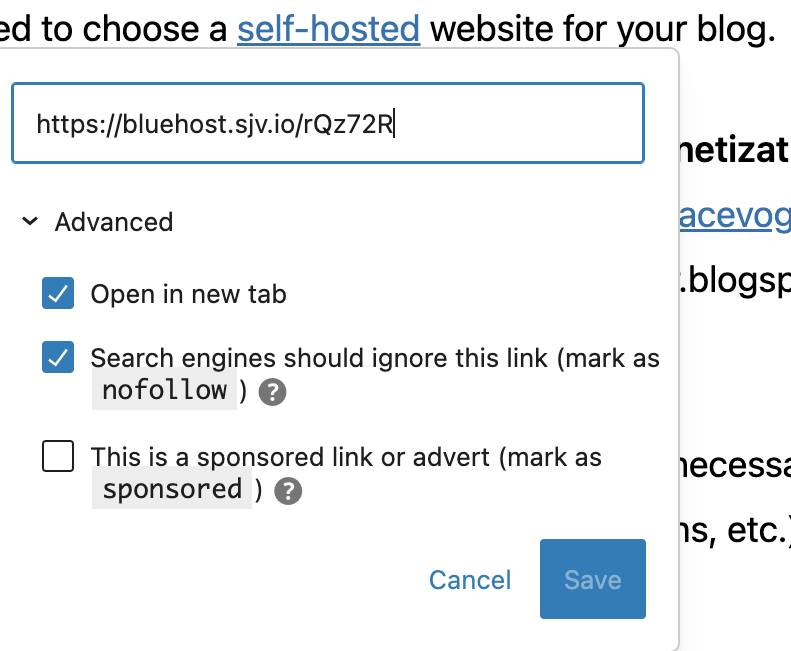
In addition to disclosing your relationship with affiliate partners, it is also important for your website ranking that you make these affiliate links “nofollow”. See, when you include a link in your blog post, it automatically reverts to “dofollow”, meaning search engines will follow that external link when they are crawling your website. The problem with this is, these affiliate links are for monetization, not SEO. Leaving your affiliate links as “dofollow”, misdirects your ranking power off of your content and can hurt your website ranking in the long run.
So how do you make an affiliate link “nofollow”? If you add an affiliate link in the Gutenberg block WordPress editor, you should have the option to edit the link by clicking on it, and clicking the pencil that appears beside it. There, a small window will pop up and you can check “Search engines should ignore this link (mark as nofollow)”. I also have my affiliate links to open in new tab so the reader is not completely clicking off my content, but that is not a requirement. That is just my preference.
19. Not Adding a Clear CTA
You just provided all this valuable content to your readers, now, what do you want them to do? Do you want them to join your email list, enroll in a course, sign up for your services, or purchase a product? Whatever your goals are with your content (and you should know your goal before you ever start writing a blog post), you need to make it clear to your readers what you want them to do next. So in this instance, I want you to sign up for my free digital product collection in the form below.
20. Not Using Pinterest for Organic Traffic
According to Pinterest, “content [on Pinterest] isn’t chronological—it’s personal. Your content shows up right as people are looking for something to try, buy or do.” This means your pin can pop up on someone’s Pinterest feed months, or even years after you post it. The lifespan of a pin on Pinterest is so much greater than posts on social media.
Don’t get me wrong, I think social media is valuable and has its place in your content strategy. But if you were to only choose one platform to market your blog posts, I would recommend it be Pinterest. Use ChatGPT to help you write pin descriptions to save you time. And create or buy Pinterest pin templates for Canva, so you are not having to design a new pin everytime you post. It’s more of a plug-in-play approach if you use templates-saving you valuable time.
21. Not Repurposing Blog Posts
You don’t have to come up with new content for every platform. Ain’t nobody got time for that. Use quotes or break up your blog post into smaller chunks for social media or email. If you aren’t using your blog content elsewhere, you are honestly wasting your own time.
22. Not Writing for your Audience
When blogging first became a popular thing, people used it as a diary of sorts to document their own lives. That worked then. It’s not going to work in 2025. Now, readers want to know “what’s in it for me?” when they read your blog post, so you have to make your blog about your AUDIENCE, not yourself.
Now, you can throw in some relatable personal stories, and I would even recommend that you do. But remember, they are stories to help you RELATE to your audience. It is never really about you.

Hey, I’m Sarah Grace— registered nurse turned blogging mentor, mama, and founder of sarahgracevogler.com. I help aspiring bloggers (just like you!) cut through the overwhelm and turn their passions into profitable online businesses. I’ve been where you are—Googling how to start a blog at 2 a.m., wondering if anyone would ever read my posts—and now I teach others how to do it with clarity, confidence, and heart. Thank you for reading this blog post and make sure to pin it to Pinterest, so you can reference it later.
15
Apr


VIEW THE COMMENTS
Add A Comment